but there are scars of war [an exhibition review]
02-10-2026 / Mona Eilers
It is dark, you venture a step
Into the trance of meaning
You enter the room and find yourself in a black playing field of cages, their mesh walls are made of fine wire. You take off your boots and move them a little further, cell by cell. You find yourself in the room installation “Hotel Aporia”.
You hear the wind
You don’t feel it
You feel uneasy, it is cosy
You’ve caught a flavour for it
It tastes like nuances
The mesh cages are lined up one after the other. They are open to walk into and lined with tatami mats. The room is darkened. The rules of the game are not explained, but you know them. You ask your bones and remember: physics, narration, stomach ache. A video is played in each cage. But the video screens are see-through, merging with the screen behind them so that the visuals culminate in a transparent ethnography of military nationalism and cultural propaganda.
In “Hotel Aporia” (2019), Singapore-born artist Ho Tzu Nyen (*1976) explores Japan’s imperialist ambitions and actions in Asia in the period before and during the Second World War. In this multi-channel installation, he examines the stories and backgrounds of various individuals who were active at that time.
Harbour of pearls, oh harbour of pearls
Alongside a philosopher from the Kyoto School in Japan, a kamikaze unit and the animation director Ryuichi Yokoyama (1909–2001), Nyen also focuses on the stories of Yasujirō Ozu (1903–1963), a filmmaker. Nyen uses archive material and film clips from the works of Ozu and Yokoyama, both of whom were commissioned to make films for war propaganda. They both find their own way of dealing with this. Whilst Yokoyama’s cartoon aesthetic creates an uncomfortable tension with a powerful pull between pop culture and the military, Ozu never shows the war scenes themselves – “but there are scars of war in many of his films after 1945”.(1)
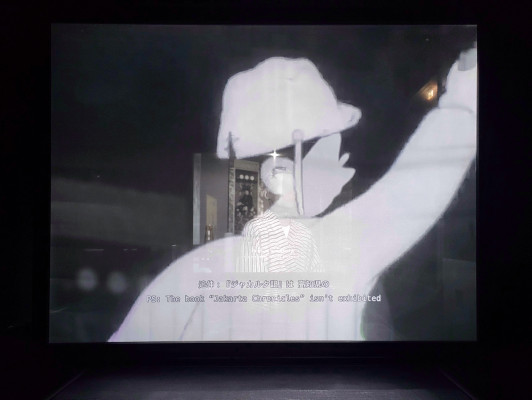
In Nyens’ videos, the figures created by both directors become faceless. Blurred or erased, they evoke, in a twisted way, the uncanny effect of portraits whose facial features are brought to life by AI. When the corner of the Mona Lisa’s mouth twitches ever so slightly – real or imagined? The anonymous individual has a flat pulse and serves as an analogy for the intertwining of historical research and life stories. The faceless do not become kitsch ghosts of the past, but evoke an interference signal, a dissonance or a state of acute alertness, like the beeping of a heart monitor in a hospital. Can their subject position be erased? Is life easier this way in times of war? Uncertainty shrouded in layers upon layers of stories.
I hear the wind
I don’t feel it
Kamikaze means
the wind of the gods
It all makes sense
Nyen himself does not speak Japanese, so for his research he works with Japanese colleagues who translate for him. The written correspondence between them is quoted in the videos, revealing the artist’s own detachment and his role as a researcher. Like a skilled ethnologist, Nyen succeeds in approaching the material from the outside and finding a way in: always on the premise that objectivity can only be achieved through the affirmation of one’s own subjectivity, in an authentic and respectful manner.
Dear Tzu
Best regards Yoko
Best regards Tzu
Best regards Tomo (2)
The (re)construction of history is a recurring theme throughout all of Nyen’s works on display in the retrospective exhibition “Time & the Tiger” at Hamburger Kunsthalle. The focus of Nyen’s artistic exploration is Southeast Asia – a collective term for a geographical region that does not fit together linguistically, culturally, or religiously, yet is held together by Western political propaganda and ideology in the aftermath of the Second World War. Nyen explores the constructed character of Southeast Asia in his ongoing work “CDOSEA (The Critical Dictionary of Southeast Asia)”: here, he questions colonial terminology and combines his conceptual research with humour and beat. Video clips from the internet and voice-overs in ten different variations are randomly combined using an algorithm, so that an ever-changing combination occurs. History meets rap, meaning is fluid – “CDOSEA" is a logical consequence in the post-digital age and definitely a sweet spot of artistic research. Like a nicely educating doom scroll.
S for Slaves
S for Soul-Stuff
Time enables history, narrative, power, hope and scars. Scars that do not heal, fade, are forgotten and covered with tattoos. An intergenerational mimesis of meanings. In two works, Nyen explores the concept of time in even greater depth. In “T for Time” and “T for Time: Timepieces”, he collages different-style video snippets to form an aesthetically and semantically heterogeneous portrayal of time.
T for Tiger
Alongside time, the tiger is a central element in the exhibition. In its dense fur the tiger carries the history of majestic exoticisation that South East Asia experiences.
The tiger leaps
It doesn't hurt anyone
Only the theodolite is broken
It is a scene oozing colonialism. The Irishman George D. Coleman, accompanied by local convicts, is surveying the jungles of Singapore with his theodolite when suddenly a tiger leaps into the frame. This frozen image becomes the setting for Nyen’s two-channel video installation “One or Several Tigers” (2017): The modern Western rationality pitted against the instinct-driven, aggressive animal that must be civilised. Nyen transforms the duel between the tiger and Coleman into a duet that the two sing together as they float through this shared moment.
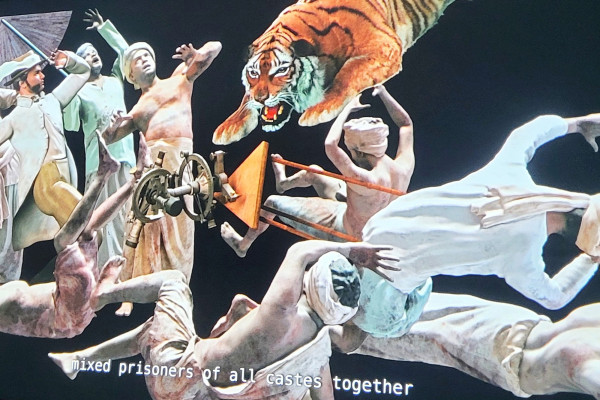
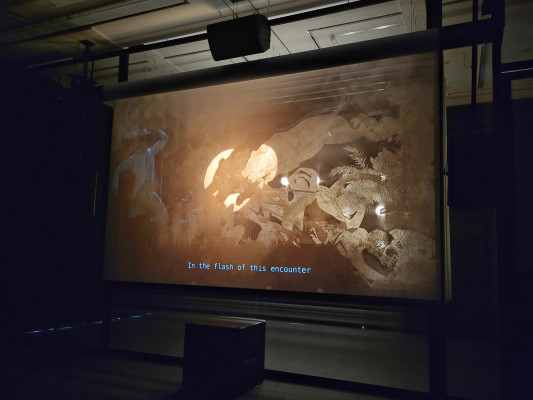
150 years after their encounter, they come together in a productive way. As if the computer-generated, visually striking images were not enough, a traditional Indonesian puppet theatre is also part of the installation. A shadow play with leather puppets adds further layers of bodies and light; the story is as poetic as it is unvarnished, like an old photographic negative print. It is a play on history and myth.
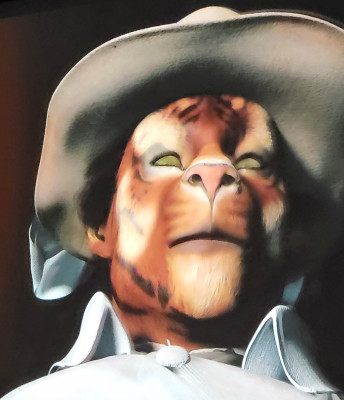
You feel a bond with the tiger
You feel the air moving when he strides next to you
but it is not the wind you are hearing.
There are scars of war
And blunt claws –
It all makes sense
…
(1) Cited from: “Hotel Aporia” (2019), Ho Tzu Nyen, 6-channel video projection, colour, 24-channel audio, 84:01 mins, video, automatic fan, lighting, current transformer, show control system.
(2) Cited from: “Hotel Aporia” (2019), Ho Tzu Nyen, 6-channel video projection, colour, 24-channel audio, 84:01 mins, video, automatic fan, lighting, current transformer, show control system.
 Share
Share